


Posts
Why Reactive Servicing of Weighing Scales Cost More in the...
Read More

When weighing is at the heart of your operation, choosing the right service provider is a business‑critical decision. Regardless of whether you’re in manufacturing, food production, logistics, or pharmaceuticals, inaccurate scales can trigger compliance issues, product losses, safety risks, and damaged customer trust.
Yet many businesses still select a service provider based on the lowest quote. While price matters, it’s rarely an indication of long‑term reliability or competence.
In our blog, we explore 5 red flags to watch out for, and how to compare service partners in ways that go far beyond just cost.
1 – No Evidence of Accreditation or Compliance

Any credible scale service provider should be able to show that they are compliant with legal metrology standards such as NAWI (Non-Automatic Weighing Instruments) regulations. This is a legal framework for engineers to perform verifications on trade-use scales (scales that are used for buying and selling of goods).
While ISO 9001 quality management certification isn’t mandatory, it is a reassuring green flag that the company has robust systems for consistency, traceability and organised processes.
If a business hesitates to provide documentation or list accreditations publicly, it’s a red flag. A lack of compliance often means shortcuts, poor calibration practices, and risk of legal issues down the line.
2 – Vague or Incomplete Service Reports

A high‑quality service provider will give detailed, traceable calibration reports including:
If reports are generic, handwritten, or missing traceability, it suggests poor quality control and may result in poor outcomes when audits are conducted.
3 – Slow Response Times or Poor Communication

Other red flags can come from a lack of clear communication, which is often the difference between a short disruption and a complete shutdown.
First and foremost, if there are delays in answering emails or calls, your ongoing relationship will rarely improve. It shouldn’t be difficult to get technicians to visit you on-site (for routine or emergency callouts). If it is, it can be an indication of a staff shortage or high workloads, meaning your business is unlikely to be prioritised.
Poor communication can also lead to a technician arriving at your business with the wrong or no parts to perform on-site repairs, due to a lack of paperwork or information at the time of booking.
4 – A One‑Size‑Fits‑All Service Approach
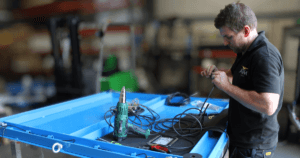
Your industry, environment, and equipment type determine what service package you need. Providers who don’t ask questions like:
…are likely prioritising speed over understanding. This kind of red flag is what usually leads to poor calibration, inadequate service plans, and missed risks.
At AWM we work closely with businesses to ensure that their requirements are met and create a servicing package suited accordingly.
5 – Pricing That Seems “Too Good to Be True”
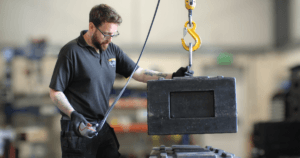
Unusually cheap service providers often hide short visit times, unqualified technicians, and non-traceable test weights. The technician may not calibrate the equipment, instead just cleaning and checking over them, along with no ongoing service support after they have left.
In weighing equipment, cheap service is often the most expensive mistake in the long run. The same scale may be accurate at 5kg but inaccurate at 500kg. Walking around a facility with a 5kg weight is a much faster and thus cheaper exercise than moving 500kg to each scale. However, how often are you using your 500kg scale at 1% of its capacity?
We go into more detail about the long-term costs and loss of profit of inaccuracies in this blog.
How to Compare Service Providers Beyond Price
When working with a service provider, ensure their test weights are fully traceable, that they will provide a detailed calibration certificate, and that they are clear with their processes for adjustments, testing, and reporting.
With high-quality calibration, your scales will be unlikely to have drift, meaning your business will not require downtime.
Evaluate Response Time and Support Guarantees
Services and calibration must work with your business. It’s important to know that when you require an engineer, your expectations are met. Ask them what their typical call-out time is in the case of an emergency. If they can send someone out within your time scales, ask that they send a technician who can fix your equipment and not an unqualified employee just to suit your requirements.
Fast support that gets you up and running is often more valuable than saving 20% on a service contract.
Check Technician Expertise and Training
The most professional service providers invest in manufacturer training, meaning they will learn equipment inside and out, alongside continuous professional development for their technicians and engineers. This ensures that they have a full understanding of many different types of scales and how they operate under different manufacturers.
Alongside this, they should have a metrology certificate to show that their staff is qualified to perform service calibrations.
Ask how technicians are trained, and how often. Do the service providers understand your site and equipment? A good provider will come to your site before conducting a service to full get to know your business and how it’ll operate for minimal downtime when they arrive to conduct a service.
Review Industry Experience
Alongside understanding the manufacturing of your scales and investing in training their teams, a service provider should have experience in your industry and sector. Again, when they visit your site for an audit, they should gain an understanding of how your business operates.
A red flag to look out for technicians being unable to service trade-approved scales, work in hazardous environments, or work with highly sensitive devices such as high-capacity weighbridges or laboratory-grade precision instruments.
Make sure the provider has proven experience in your sector before continuing.
Evaluate Customer Feedback and Case Studies
Recent trends show that businesses prefer proof and word of mouth over price. If you can see evidence of case studies, testimonials, and long-term relationships with other reputable businesses, this is a very good green flag to look out for. An excellent service provider will not hide their achievements.
If they avoid sharing references, that’s a red flag.
Choosing a service provider for your weighing equipment is so much more than cost.
Your scales impact product quality, regulatory compliance, customer experience, and operational efficiency. A reliable partner protects your business from risk and keeps everything running smoothly.
By watching out for red flags, comparing providers on capability, quality, and responsiveness, you’ll be in a much stronger position to select a service partner who genuinely adds value and helps safeguard your operation.
At AWM we offer free audits, dedicated technicians, along with service and calibrations suited to your business needs. Contact us to discuss more. Fill in the form below, or contact us on sales@awmltd.com or 01284 701222.