


Posts
5 Red Flags When Choosing a Service Provider for Weighing...
Read More

If you have owned a set of scales for a long time, have you noticed that the weight displayed on your digital scale slowly climbs and falls?
If so, this is called “drifting”, and it can be due to several different reasons. In this blog post, we explore those reasons and the consequences of not regularly servicing your equipment.
Environmental Factors

All weighing scales, but especially high-precision analytical balances, such as the Ohaus scales, are incredibly sensitive to their surroundings.
Temperature changes can cause internal electronic components to expand or contract and alter the scale’s sensitivity. It is best practice to keep your scales in an environment that has a consistent temperature to prevent drift.
Wind and Air Currents from something as simple as nearby air conditioning, a window, or even a person walking past can cause a fluctuating reading on a sensitive balance. But it’s not just balances that are affected by wind. Quite often weighbridges that are exposed to the elements drifting up to 200kg or more as wind gets under the bridge and lifts the structure. Consider where you position your scales in conjunction with footfall and its exposure to the elements.
Mechanical “Creep”

Often confused with drift, creep is when a load is left on a scale for an extended period. In normal circumstances, the load cell physically changes under the weight applied before returning to its original state. However, where a load is left, the loadcell takes time to fully settle and later recover when the load is removed, causing the scale to slowly return to 0.
This often occurs mostly in new scales, but if you monitor the weight in a large silo or leave a heavy item on your scale all day, you may see the weight “creep” slightly higher or lower over time when adding additional loads.
Electronic Interference
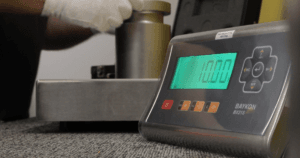
Modern digital scales rely on tiny electrical signals to translate the load applied to a weight display. A common cause of drift is when these signals are compromised by moisture ingress, where condensation or water enters the junction box or wicks into the cable, causing resistance changes and erratic readings.
Electrical noise from radio frequencies or electromagnetic interference from large power lines or motors can also disrupt the signal and create a fluctuating reading on the weight indicator.
Component Age and Wear
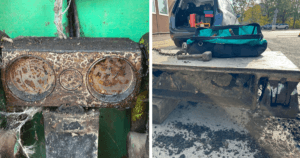
Even the best equipment has a lifecycle and over many years of use loadcells can lose their responsiveness and show weight errors due to hysteresis, when a load cell does not return to its starting point.
Residue any kind of dirt or debris can also build up around the loadcell or under the platform and this mechanical binding can restrict the scales movement.
Improper Setup and Maintenance
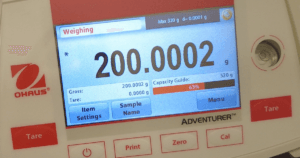
In some cases, apparent drift is caused by mechanical interference. For example, if a filling system uses rigid pipework connected directly to a vessel positioned on a scale, the pipework can apply force during filling. Without properly designed flexible connections, this strain can influence the load cell, causing the displayed weight to change as the system operates.
Additionally, unstable surfaces can also cause weight errors. If the scale rocks slightly, the load cell will interpret this movement as a constantly changing weight.
Precision electronics also need time to reach a stable internal operating temperature and using a scale immediately after plugging it in will likely cause weight drift.
What Can Be Done About Drifting?

Drifting causes inaccuracies in your weights, leading to reduced profits and stock discrepancies, leading to potentially delay deliveries. Read more about the hidden costs of these discrepancies in our blog about why reactive servicing of weighing scales costs more in the long run.
For the best accuracy and reliable, stable weight readings, it is important to make sure your scale is suitable for its intended use and location.
AWM offers a free [link to consultancy] consultancy service where our knowledgeable technicians can review your requirements and advise on the best scale for your needs. It is also important to keep up regular servicing and calibration visits.
Our friendly and dedicated team of service engineers is ready to repair, service, or calibrate your weighing scales.
Fill in the form below or contact sales@awmltd.com or call 01284 701222 to speak to our team and ensure optimum weighing performance and accurate, reliable, and stable weights for your business.