Posts
QBoid for Mobile Dimensioning – When a Stationary Scanner Isn’t...
Read More

Mobile dimensioning offers a flexible approach. Warehouse layouts are designed around the movement of goods, people, and equipment. But as operations grow, change and become more complex, the original layout doesn’t always work as well as it once did.
Adding new processes, introducing additional product lines or simply handling a wider variety of goods can create challenges for dimensioning. A fixed dimensioning station may work perfectly for one part of the operation, but what happens when goods don’t naturally pass through that point?
Stationary dimensioning systems are an effective solution when goods follow a defined route through the warehouse. Items can be presented to the system at a designated point, measured and then continue through the process.
But not every warehouse operates this way.
Goods may arrive at different locations, move between multiple areas or require measurement at different stages of the operation. Large, irregular or non-conveyable items may also be difficult to bring to a fixed dimensioning station.
Trying to accommodate these processes can result in additional handling and unnecessary movement around the warehouse.
Instead of changing the warehouse to suit the dimensioning system, mobile dimensioning allows the measurement process to fit around the warehouse.
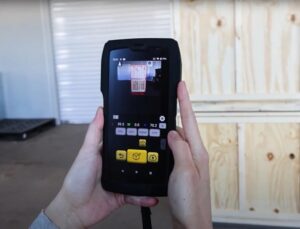
Mobile dimensioning changes where measurement takes place.
Rather than moving an item to a dedicated scanning station, an operator can take the dimensioning equipment directly to it. This can be particularly useful in warehouses where space is limited, workflows are spread across multiple areas or goods vary significantly in size and shape.
The benefits can include:
For operations handling a diverse range of products, this flexibility can make a significant difference.
Not everything that moves through a warehouse is a neat box.
Irregularly shaped goods, oversized items and products that cannot easily pass through a fixed scanning system can present particular challenges. Manually measuring these items takes time and introduces the potential for inconsistent measurements.
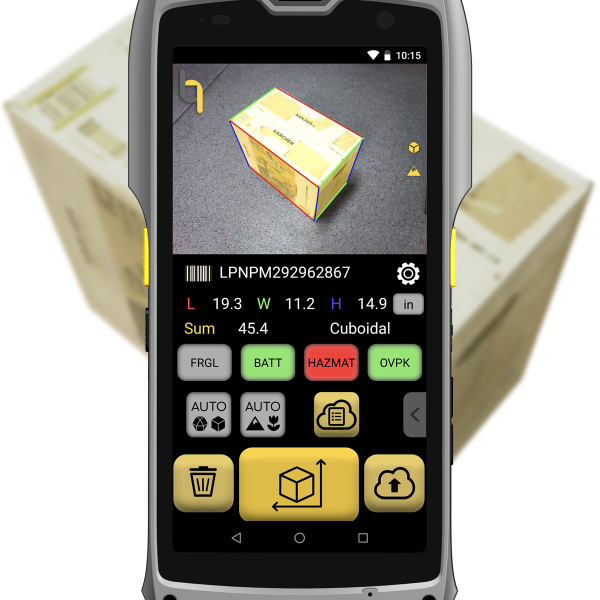
The QBOID M2 Perceptor is designed for this type of mobile dimensioning application, using integrated 3D sensors to capture the dimensions of items directly.
It provides accuracy of ±5mm for cuboidal objects and ±10mm for irregular shapes using the parcel app, allowing operators to capture useful dimensional data without relying on manual measurements.
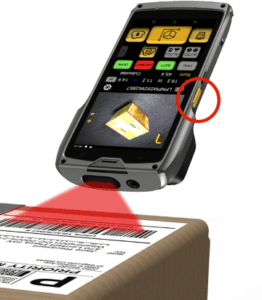
Dimensioning is often only one part of the data that needs to be captured.
Identifying the item at the same time can help create a more efficient workflow, particularly in logistics and warehousing environments where dimensions need to be associated with a specific product, parcel or shipment.
The QBOID M2 Perceptor incorporates a 1D/2D barcode scanner alongside its 3D imaging technology. This allows operators to capture dimensional and barcode information using the same handheld device.
The device can also connect using Wi-Fi, Bluetooth and USB-C, providing options for integrating captured information with existing systems and processes. Uploading results can be done manually but QBOID uses the powerful API to send the data to an endpoint for integration into systems.
The mobile dimensioner QBOID M2 Perceptor is a powerful piece of hardware but is coupled with a choice of software that is designed around the use case. Users can opt for the Parcel app, Pallet app or the AI Workflow app to customise the process. The Parcel app covers the smaller items handled in bulk every day, whilst the Pallet app allows the user to take 2 or more images of a pallet and intelligently stitches them together to capture accurate dimensions as well as multiple images.
The AI Workflow app allows more data to be recorded such as images of paperwork dockets, OCR of labels or weight indicator screens, check boxes for goods receivers or signature recording for quality monitoring.
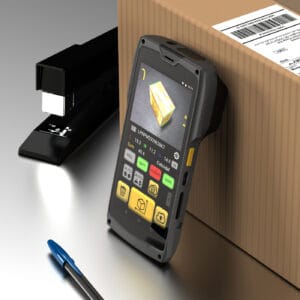
Over time, and as businesses grow, warehouse operations rarely stay the same.
New customers, different products, increased volumes and changes to fulfilment processes can all affect how goods move through a facility. A mobile dimensioning system can provide an adaptable option where processes aren’t tied to a single location.
The QBOID M2 Perceptor weighs just 440g and is designed for portable use. Its IP65-rated casing and semi-rugged 1m drop rating also make it suited to the demands of busy operational environments.
Rather than allocating valuable floor space to another permanent station, operators can carry the equipment to wherever dimensioning is required.
Mobile dimensioning isn’t intended to replace stationary dimensioning system. The two can work together.
For high-volume operations with a clearly defined workflow, an automated or fixed system may be the most efficient option. But where goods are handled across different locations, workflows are less predictable or items are difficult to bring to a fixed station, mobility can provide a practical alternative.
Choose a dimensioner that works for your warehouse. Consider how items move around your environment and whether a static dimensioner would take up a lot of space.
If the answer is in ‘one consistent location’, a stationary solution may be ideal.
If the answer is ‘wherever the goods are’, mobile dimensioning could provide the flexibility your warehouse needs.
Every warehouse has its own layout, processes and challenges. The right dimensioning solution should support those processes rather than forcing unnecessary changes to them.
At AWM, we will help you assess your operation and identify the most suitable approach, whether that means a fixed dimensioning system, mobile equipment or a combination of technologies.
Want to explore whether mobile dimensioning could work for your warehouse? Fill in the form below to talk to us about your requirements.