Posts
Mobile Dimensioning – Overcoming Warehouse Layout Challenges
Read More

Stationary dimensioning systems have an important role to play in modern warehousing. When goods follow a consistent route through a defined area, a fixed scanner can provide fast, reliable dimensional data with minimal operator involvement. But not every warehouse works that way. Goods don’t always arrive at the same point. They aren’t always the same size or shape. And they don’t necessarily follow a neat, predictable journey from receiving to despatch. When the operation doesn’t fit the fixed scanning point, QBOID for mobile dimensioning can provide the flexibility needed to measure goods where they are actually being handled.
A stationary dimensioning system is particularly effective when goods are presented to it in a consistent way.
For example, a warehouse may have a dedicated packing or despatch area where every parcel passes through the same point before leaving the building. Installing a fixed dimensioning system here can automate the process and capture dimensions as part of the existing workflow.
For high-volume, repetitive operations, this can be exactly what is needed.
The challenge comes when goods don’t naturally pass through that point.
Moving goods to a fixed dimensioning station might sound straightforward. But across a busy warehouse, every additional movement takes time.
Consider goods that:
In these situations, sending an operator and goods to a fixed scanner can introduce unnecessary handling into the process.
And if the item is difficult to move in the first place, the problem becomes even greater.
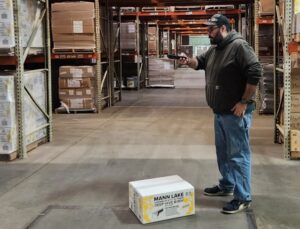
QBOID for mobile dimensioning takes a different approach.
Instead of creating a single location where every item must be measured, the equipment can be taken directly to the goods.
This can give warehouse teams greater flexibility to measure items where they are already being handled, without creating an additional journey through the warehouse.
For operations dealing with a varied product mix, this can be particularly useful.
An operator can identify an item, capture its dimensions and continue with the existing workflow, rather than stopping to transport the goods to a dedicated scanning point.
One of the limitations of designing a dimensioning process around a fixed station is that warehouses don’t only handle standard cartons.
Products can be large, irregular, on a pallet, or awkwardly shaped. Some may not be suitable for passing through a conventional scanning point at all.
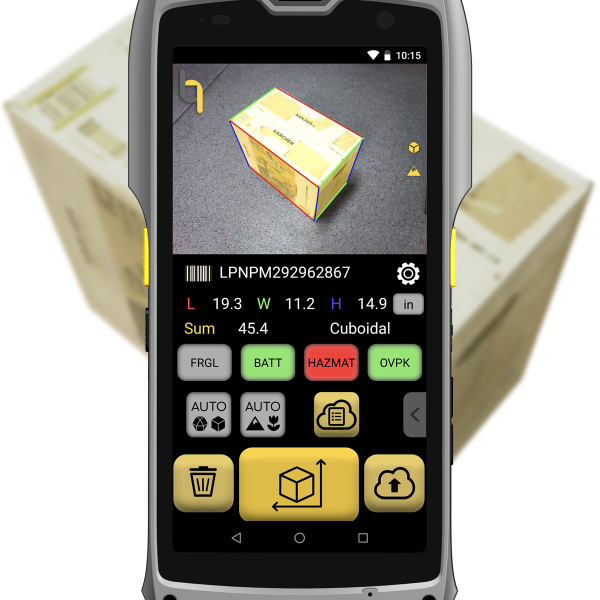
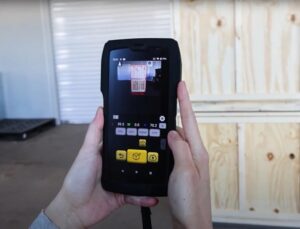
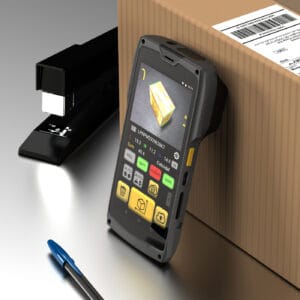
The QBOID M2 Perceptor is a handheld dimensioner designed to provide a portable approach to measurement, using 3D sensing technology to capture the dimensions of both cuboidal and irregular objects.
It can measure cuboidal objects to ±5mm and irregular shapes to ±10mm, providing dimensional data without relying on manual measurements.
That means dimensioning doesn’t have to stop simply because an item doesn’t fit neatly into the usual workflow.
In many warehouse environments, dimensions are only useful when they can be associated with the correct item.
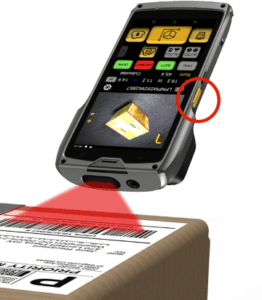
That’s why the QBOID M2 Perceptor combines dimensioning with integrated 1D/2D barcode scanning.
An operator can capture the item’s barcode and dimensional information using the same handheld device, helping to reduce the need for separate data capture steps.
The device also supports Wi-Fi, Bluetooth and USB-C connectivity, giving businesses options for connecting captured data with their wider systems and processes over file transfer or using API.
Not necessarily. The right approach depends on how your operation actually works.
A fixed dimensioning system can be the better choice where:
A handheld dimensioner can be more appropriate where:
And in some operations, the best solution could be a combination of both.
A fixed system can handle high-volume, predictable workflows, while a handheld dimensioner can deal with the exceptions that don’t fit the standard process.
The purpose of dimensioning technology is to make your operation more efficient, and not to create another process that your warehouse has to work around.
Before choosing a system, consider where dimensioning actually needs to happen.
If virtually every item passes through one location, a stationary scanner could be the most efficient solution.
But if your warehouse has multiple measurement points, awkward goods or workflows that don’t follow a fixed route, a handheld dimensioner could be the missing piece.
The QBOID M2 Perceptor weighs just 440g and has an IP65 rating with a semi-rugged 1m drop rating, making it designed for use in active warehouse environments rather than being tied to a permanent workstation.
At AWM, we can help you assess your workflow and identify the dimensioning approach that makes the most sense for your operation; whether that’s stationary, mobile or a combination of both.
Want to explore whether mobile dimensioning could work for your warehouse? Fill in the form below and we will get back in touch to discuss your requirements.